The squelch of mud underfoot, the sight of umbrella phalanxes crossing city streets – spring showers can send us scrambling. But the rains bring with them a refreshing aroma beloved by perfumers. Thunder and lightning, wet earth and damp concrete commingle to create petrichor, the scent of the season.
Few things herald the arrival of spring like rain showers: heavy clouds releasing their drops onto the earth to nourish the blossoms beneath. We quickly pop our hoods, thrust our umbrellas skywards or simply run for cover, huddling under an awning. The aroma that accompanies this theatrical scenery? Petrichor.
Taken from the Greek words “petra” (stone) and “ichor” (the blood of the gods in Greek mythology), the scent occurs when rain hits dry ground. While the ancient civilization was the first to recognise this interplay of the divine and the earthly, the term was first published in the 1964 Nature article “Nature of Argillaceous Odour”, written by Australian researchers Isabel Joy Bear and Richard Grenfell Thomas.
It’s not only created through rain itself but the intermingling with its milieu: plants, bacteria and lightning. The scent molecule released, geosmin, is also related to terpenes, the source of the majority of plants’ smell. Thunderstorms create the ozone, which contributes to the scent’s fresh facets. All of these factors result in something earthy and aquatic, refreshing yet moody. The added sensorial elements of rain – the drops landing on our skin, the sound of it hitting the earth – means that our entire being feels petrichor when we smell it.
How this is interpreted by perfumers can fall into territories that are either deep and dark or clear and transparent. Some focus more on the green, mossy, dirt aspects of the ground; others covered in mossy accents. On the
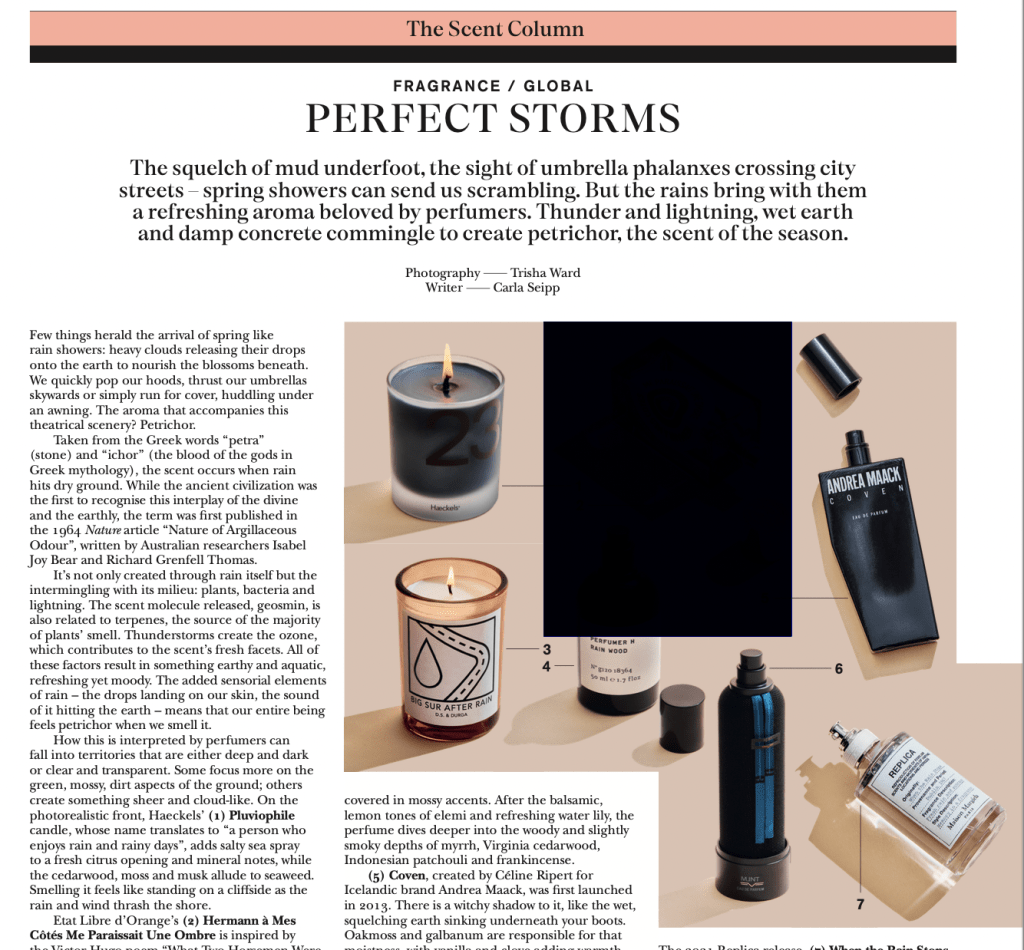
photorealistic front, Haeckels’ Pluviophile candle, whose name translates to “a person who enjoys rain and rainy days”, adds salty sea spray to a fresh citrus opening and mineral notes, while the cedarwood, moss and musk allude to seaweed.
Etat Libre d’Orange’s Hermann à Mes Côtés Me Paraissait Une Ombre is inspired by the Victor Hugo poem “What Two Horsemen Were
Thinking in the Forest”. A woody aromatic creation crafted by Quentin Bisch and released in 2015, it bursts with refreshing pepperwood and galbanum,its geosmin mixing with rose oil before settling into a warmer and skin-like ambrosian base – hints of the forest lingering in the patchouli and vetiver.
Brooklyn-based innovators DS & Durga boast several petrichor scents. Its Concrete After Lightning candle is the embodiment of a heavy metropolitan downpour, while Big Sur After Rain plays out among the eucalyptus groves off Highway 1 on the Californian coast. It crafts a green world through eucalyptus shoot and leaf, with fresh coastal rain and pacific spray notes, and magnolia adding a floral touch to emulate the blossoming plant life.
Lynn Harris of Perfumer H has created a sophisticated classic with 2023’s Rain Wood, which brings to mind an uprooted tree that has collapsed and split on the ground after a storm, covered in mossy accents. After the balsamic, lemon tones of elemi and refreshing water lily, the perfume dives deeper into the woody and slightly smoky depths of myrrh, Virginia cedarwood,Indonesian patchouli and frankincense.
Coven, created by Céline Ripert for Icelandic brand Andrea Maack, was first launched in 2013. There is a witchy shadow to it, like the wet, squelching earth sinking underneath your boots. Oakmoss and galbanum are responsible for that moistness, with vanilla and clove adding warmth, while labdanum and whiskey bring smokiness.
Christopher Brosius is one of the originals when it comes to conceptual creations, having co-founded Demeter in 1992 before launching his own label, CB I Hate Perfume, in 2004. His 2005 release, To See a Flower, is centered around floral notes of hyacinth, daffodils, jonquils and crocuses but has that undeniable post-rain shower quality thanks to wet dirt and moss elements. Australian house Mihan Aromatics also had freshness on its mind when creating 2019’s Petrichor Plains, which features rain notes, neroli, cedarwood, cinnamon, vanilla, musk, saffron, amber and Australian sandalwood.
Created by Thierry Bessard and launched in 2016, M.Int’s Rainy City replaces the literal earth with tea notes, including those of the green and black variety, plus lemon and bergamot. A woody aquatic scent, its vetiver and musk base notes feel fresh, much like a metropolis cleansed of its grime.
The 2021 Replica release, When the Rain Stops, is set in 1967 Dublin. Perfumer Fanny Bal added rose and jasmine to the heart of the scent, bringing tender floral blooms to the enlivening mix of bergamot, pink pepper and pine tree.
Charenton Macerations’ Asphalt Rainbow, an underground darling launched in 2015, is where nature meets the sharp screech of tires on concrete. Perfumer Cecile Hua mixes rose absolute, lily
of the valley and ylang-ylang with leather and spray-paint aerosols. Galbanum and patchouli add a wet element. A traditional petrichor potion it is not but there is a haunting beauty to it. It’s tough yet beautiful, poetic floral futurism.
From the forest to the city, petrichor evokes beauty in any setting. Like the rain showers that produce it, it is fleeting, its traces disappearing once the sun reappears. While the sidewalk and muddy paths will dry, the memory of it will remain long after spring has come and gone.


Leave a Reply