The world’s variety of tea is vast, with flavours that read like a perfumer’s manual: smoky, herby, floral, musky. Read on and you’ll realise that you might be dabbing tea onto your pulse points as often as you take time to enjoy your favourite brew.
Drinking a cup of hot tea as the temperature starts to drop is a seasonal turning point that heralds the arrival of autumn. My delicate porcelain cup and the wafting steam combine to make each cautious sip something contemplative, moody and full of nuance and flavour.
Tea, like fragrance, comes in many forms and from a variety of origins: the earthy, malty nature of assam tea grown in India’s Brahmaputra river valley; the unmistakable smoky character of lapsang souchong from the Wuyi mountains in the Fujian province of China; the honey and vanilla notes of rooibos from the Cederberg mountains of South Africa’s Western Cape province. In the perfumer’s palette, green tea can add herbaceous and fresh facets, while delicate white tea conjures up flowery, fresh and ever-so-slightly musky tones.
Some fragrances rely on natural tea extractions, while others use accords constructed with ingredients such as alpha and beta ionones, guaiac wood and theaspirane.
The 1990s were defined by wispy and lightweight scents. The genre truly hit the mainstream with releases such as Bulgari’s Eau Parfumée Thé Vert (1992) by Jean-Claude Ellena, Calvin Klein’s CK One (1994) by Harry Fremont and Alberto Morillas, and Elizabeth Arden’s Green Tea (1999) by Francis Kurkdjian. Decades later, Bulgari Eau Parfumée Thé Vert still holds up as a sophisticated and uplifting staple fragrance for many and features green-tea notes alongside neroli and bergamot.
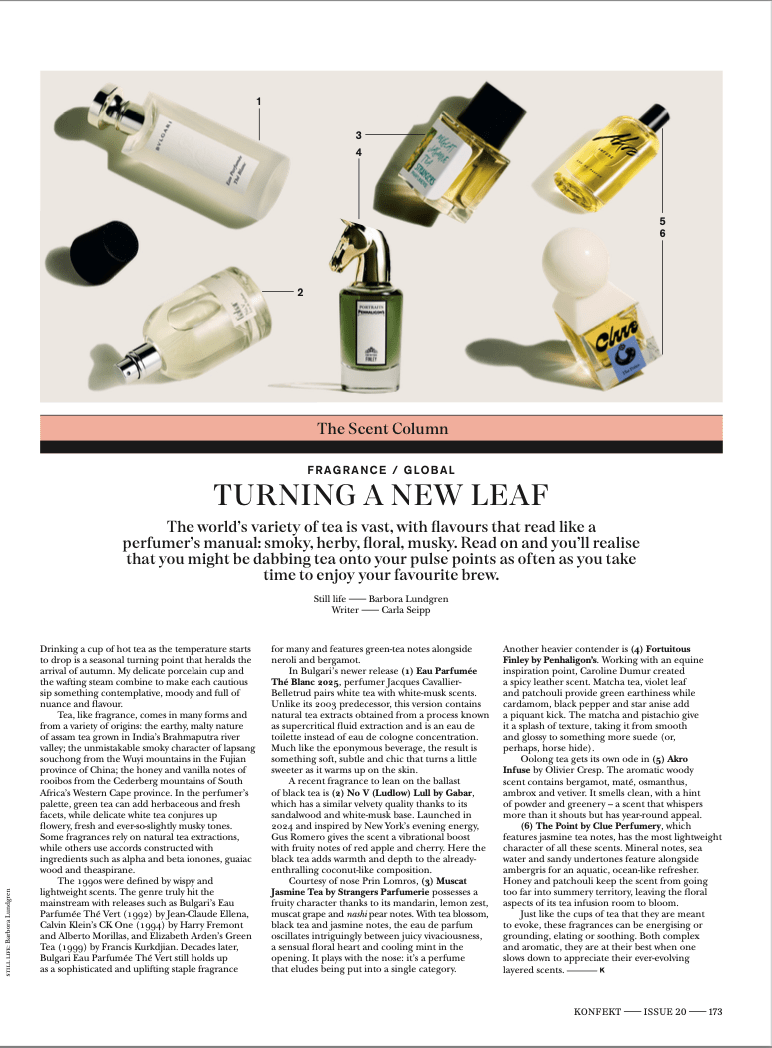
In Bulgari’s newer release Eau Parfumée Thé Blanc 2025, perfumer Jacques Cavallier-Belletrud pairs white tea with white-musk scents. Unlike its 2003 predecessor, this version contains natural tea extracts obtained from a process known as supercritical fluid extraction and is an eau de toilette instead of eau de cologne concentration. Much like the eponymous beverage, the result is something soft, subtle and chic that turns a little sweeter as it warms up on the skin.
A recent fragrance to lean on the ballast of black tea is No V (Ludlow) Lull by Gabar, which has a similar velvety quality thanks to its sandalwood and white-musk base. Launched in 2024 and inspired by New York’s evening energy, Gus Romero gives the scent a vibrational boost with fruity notes of red apple and cherry. Here the black tea adds warmth and depth to the already-enthralling coconut-like composition.
Courtesy of nose Prin Lomros, Muscat Jasmine Tea by Strangers Parfumerie possesses a fruity character thanks to its mandarin, lemon zest, muscat grape and nashi pear notes. With tea blossom, black tea and jasmine notes, the eau de parfum oscillates intriguingly between juicy vivaciousness, a sensual floral heart and cooling mint in the opening. It plays with the nose: it’s a perfume that eludes being put into a single category.
Another heavier contender is Fortuitous Finley by Penhaligon’s. Working with an equine inspiration point, Caroline Dumur created a spicy leather scent. Matcha tea, violet leaf and patchouli provide green earthiness while cardamom, black pepper and star anise add a piquant kick. The matcha and pistachio give it a splash of texture, taking it from smooth and glossy to something more suede (or, perhaps, horse hide).
Oolong tea gets its own ode in Akro Infuse by Olivier Cresp. The aromatic woody scent contains bergamot, maté, osmanthus, ambrox and vetiver. It smells clean, with a hint of powder and greenery – a scent that whispers more than it shouts but has year-round appeal.
The Point by Clue Perfumery, which features jasmine tea notes, has the most lightweight character of all these scents. Mineral notes, sea water and sandy undertones feature alongside ambergris for an aquatic, ocean-like refresher. Honey and patchouli keep the scent from going too far into summery territory, leaving the floral aspects of its tea infusion room to bloom.
Just like the cups of tea that they are meant to evoke, these fragrances can be energising or grounding, elating or soothing. Both complex and aromatic, they are at their best when one slows down to appreciate their ever-evolving layered scents.
 Carla Seipp
Leave a comment